
ITIL® (Version 5) has landed, and it’s the biggest shake-up the framework has seen since ITIL 4 arrived back in 2019. With a new certification pathway for 2026, it’s understandably raised more than a few queries, especially for those who are ITIL 4 certified, wondering what’s changed.
This guide breaks down ITIL 4 vs ITIL (Version 5) properly, covering what’s new and what that means for your certification journey.
Watch the webinar: ITIL® (Version 5) explained by an ITIL Master
ITIL 4 vs ITIL (Version 5): at a glance
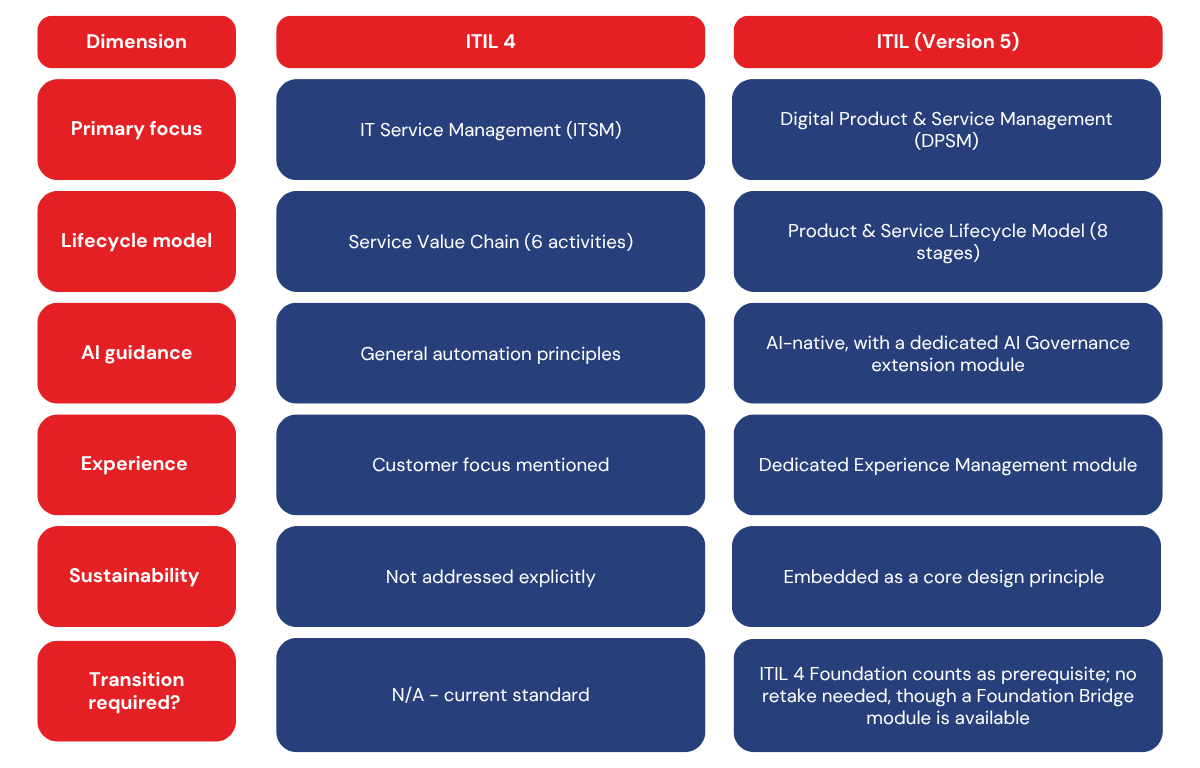
We’ll unpack ITIL 4 vs ITIL (Version 5) in detail throughout this guide. But if you’re short on time, here are the key differences at a glance:
What is ITIL (Version 5)?
ITIL (Version 5) is the latest release in the ITIL certification series, live since February 2026. It keeps the fundamentals ITIL professionals already rely on, while bringing four new areas into scope: digital product and service management, experience design, sustainability, and responsible AI practice.
It builds on the foundations of ITIL 4, rather than replacing it, refreshing things for where the industry’s headed next – think evolution, not reset.
For a deeper breakdown, head to our what is ITIL (Version 5)? blog.
Why has ITIL 4 been updated?
ITIL has been updated to keep pace with an industry that’s moved on fast. ITIL 4 launched seven years ago, and since then, the digital landscape has dramatically changed. AI is now a part of our day-to-day lives – both inside and outside of work – and there’s a bigger focus on value-driven delivery and sustainability than there was back in 2019.
The scope has changed, too. Rather than centring on IT alone, ITIL (Version 5) takes a broader view of service management, built to work just as well for product, customer experience, digital transformation, and technology teams.
ITIL 4 vs ITIL (Version 5): what’s changed?
If you’ve invested time in an ITIL 4 certification, here’s the reassurance: ITIL (Version 5) builds on what you know rather than starting from scratch. The breakdown is roughly 40% carried over from ITIL 4, 36% entirely new, and 24% updated or refreshed, so a good chunk of what you’ve already learned still holds.
Here’s where the changes sit.
Scope: services expand into products and services together
ITIL 4 centred on service management. ITIL (Version 5) widens that out to cover digital product and service management (DPSM) too, so the framework now reflects how organisations operate, spanning product, experience, and delivery functions, not just IT.
AI: a core focus rather than a bolt-on
ITIL 4 touched on automation and emerging AI use, but it wasn’t the fixture it is today. ITIL (Version 5) makes it central, with guidance around it that helps teams use it with clarity and control, rather than working it out as they go. This is covered by the ITIL AI Capability Model – known as the 6C model – which groups AI use into six areas:
- Creation
- Curation
- Clarification
- Cognition
- Communication
- Coordination
A dedicated AI Governance extension module, due for release on GEL in December 2027, will build on this with additional best practice for responsible AI adoption.
Unified lifecycle: a return to an end-to-end framework
ITIL 4 moved away from a defined lifecycle altogether, running instead on a Service Value Chain of six flexible activities – Plan, Improve, Engage, Design & Transition, Obtain/Build, and Deliver & Support – that combined into different value streams depending on the work. ITIL (Version 5) brings the lifecycle concept back into view, expanding it into eight explicit stages:
- Discover
- Design
- Acquire
- Build
- Transition
- Operate
- Deliver
- Support
If that structure feels familiar, that’s because it echoes the previous five-stage lifecycle from ITIL v3, reintroduced with more detail and widened to cover products as well as services.
Sustainability: embedded across the framework
ITIL (Version 5) embeds sustainability throughout the framework rather than treating it as optional. This encourages organisations to consider long-term environmental, social and operational impacts when designing and delivering digital products and services.
Experience: a new core module
ITIL (Version 5) introduces a dedicated Experience Management module covering both customer and employee experience. While ITIL 4 touched on this, it wasn’t formalised. Now it’s at the centre of ITIL (Version 5).
Certification path: what’s changed?
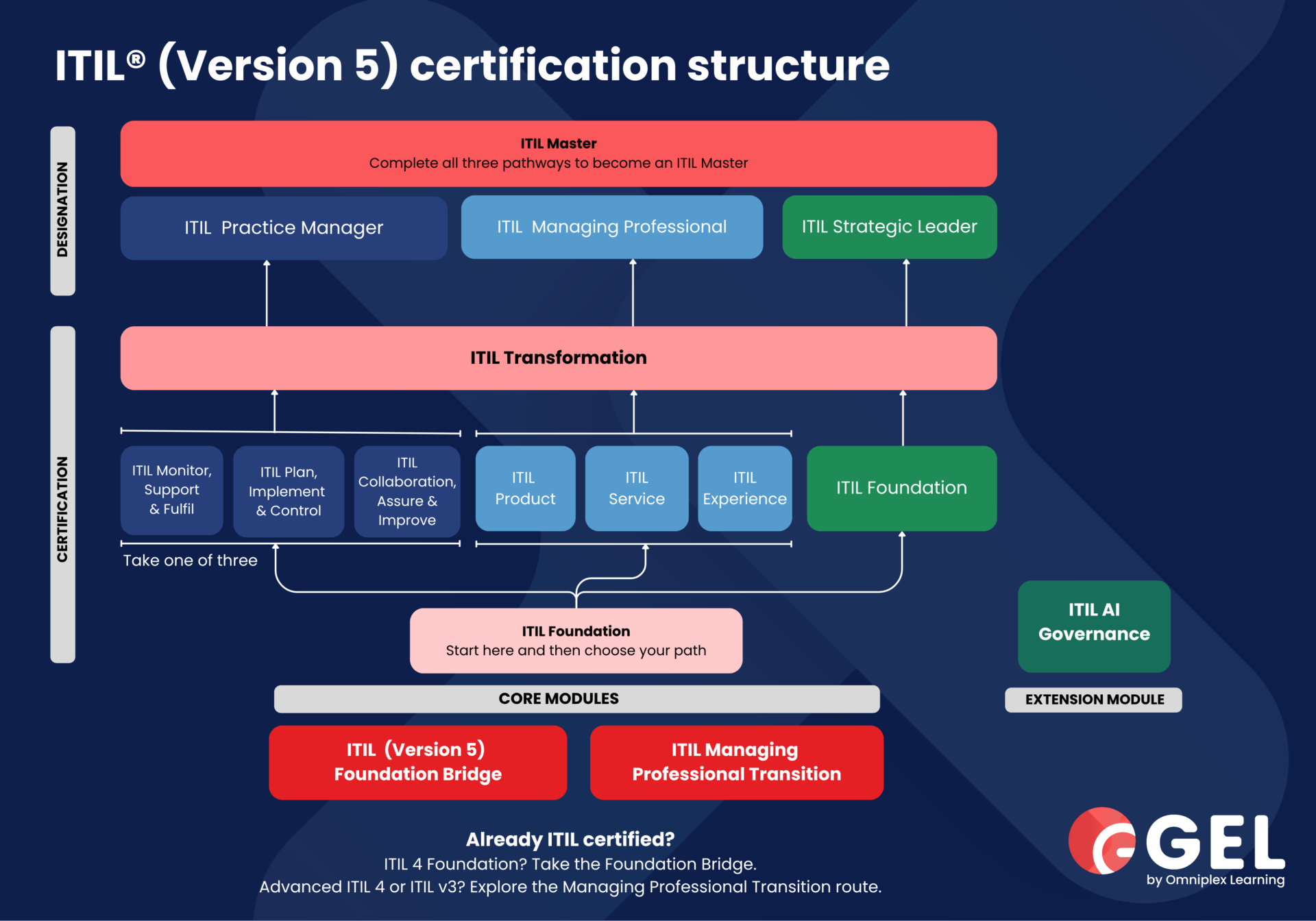
ITIL (Version 5) streamlines the certification journey while retaining a clear progression from Foundation through to Master. As with ITIL 4, everyone begins with the Foundation certification before moving on to advanced qualifications. If you already hold an ITIL 4 Foundation certification, you can progress directly to ITIL (Version 5) advanced modules, although the optional ITIL Foundation Bridge (Version 5) provides a shorter route to update your Foundation credential with the latest content.
ITIL (Version 5) keeps the familiar pathways from ITIL 4 but streamlines the certifications within each. Practice Manager now offers a choice of one of three qualifications, focusing on five specific practices. Managing Professional now provides certifications focused on Product, Service and Experience management. Strategic Leader, as you would expect, continues to focus on the strategic application of ITIL. Finally, the ITIL Transformation certification has been introduced to help practitioners apply the ITIL framework.
ITIL 4 vs ITIL (Version 5) FAQs
Is ITIL 4 still valid in 2026?
Yes. ITIL 4 certifications remain valid and respected. ITIL (Version 5) is being introduced gradually. ITIL 4 Foundation is accepted as a prerequisite for all ITIL (Version 5) advanced modules, though you can take a Foundation Bridge course, if you’d like to catch up.
Do I need to retake my ITIL Foundation if I have ITIL 4?
No. Your ITIL 4 Foundation is fully recognised as the prerequisite for ITIL (Version 5) advanced qualifications, so you do not need to retake it. That being said, PeopleCert certifications are valid for three years, so you will need to move to ITIL (Version 5) at some point.
What’s the biggest change between ITIL 4 and ITIL (Version 5)?
The scope expansion from IT Service Management to Digital Product and Service Management (DPSM), combined with AI being built into the framework by design. It’s seen as more of an evolution than a revolution but these are the two most significant changes that impact IT and service professionals.
How is the ITIL Foundation (Version 5) exam different from ITIL 4?
The ITIL Foundation (Version 5) exam places greater emphasis on the Value System (40% of the exam compared with 15% in ITIL 4).
Is ITIL Foundation (Version 5) harder than ITIL 4 Foundation?
The increased emphasis on the Value System means candidates need a strong understanding of how governance, guiding principles, the service value system and practices interconnect. However, most learners find the overall level of difficulty comparable to ITIL 4 Foundation, provided they study the updated syllabus.
Start Your ITIL (Version 5) journey with GEL. Speak to one of our team today.