ITIL® Foundation Bridge is a condensed version of ITIL Foundation (Version 5), focusing on the updates introduced by the new version.
It offers a fast, focused route for ITIL 4 certificate holders to upgrade to ITIL Foundation (Version 5).
Syllabus
Module 0 – Welcome to ITIL Foundation
Module 1 – The four dimensions of product and service management
Module 2 – The four dimensions of service management
Module 3 – The digital product and service lifecycle
Module 4 – The ITIL service value system
Module 5 – Continual improvement
Module 6 – Identifying, mapping and managing value streams
Module 7 – The practice exams
Module 8 – ITIL Foundation wrap-up
Exams
To achieve the ITIL® Foundation Bridge qualification, you must successfully pass the ITIL® Foundation Bridge exam. The ITIL exams are available online through a service provided by PeopleCert.
Upon completing this course, you will be equipped to begin preparing for the Foundation exam. To aid in your preparations, this ITIL Foundation eLearning course includes two practice exams designed to mirror the actual exam environment.
Before scheduling your exam, ensure that your device meets the necessary technical standards. For detailed instructions and further assistance, please refer to the PeopleCert website.
You should receive your exam voucher when you’re successfully enrolled on the course. For additional details, check the GEL Support & FAQs page.
ITIL® Foundation Bridge exam
This is a multiple-choice “Objective Test Question” (OTQ) exam consisting of 20 questions
There is a time limit of 30 minutes to complete the exam
The exam is closed book, with only the provided materials being permitted for use
The pass mark for the exam is 65%: you must answer at least 13 out of 20 questions correctly
Passing this exam will allow candidates to proceed to exams for higher-level ITIL qualifications
FAQ
What is ITSM?
ITSM stands for ‘IT Service Management’. It involves using policies, procedures, and best practices to optimize IT services for clients and employees.
What is ITIL (Version 5)?
ITIL (Version 5) is the next evolution of ITIL, the world’s most widely adopted framework for IT service management. Building on the foundations of previous ITIL versions, it expands the framework beyond traditional IT service management into a unified model for managing digital products and services end-to-end covering everything from discovery and design through to delivery, support, and continual improvement.
Where earlier versions focused primarily on IT services, ITIL (Version 5) reflects the way modern organisations actually operate: digitally-led, product-centric, and increasingly shaped by AI. It provides the common language, guiding principles, and practical best practices that teams across IT, product, and business functions need to deliver consistent value, adopt AI responsibly, and improve continuously.
What does ITIL stand for?
Previously, ITIL stood for the ‘Information Technology Infrastructure Library’. The framework has evolved to the point where it is updated so often that it cannot be considered a static ‘library’. Because of this, the name no longer stands for anything.
What does the ITIL certification path look like?
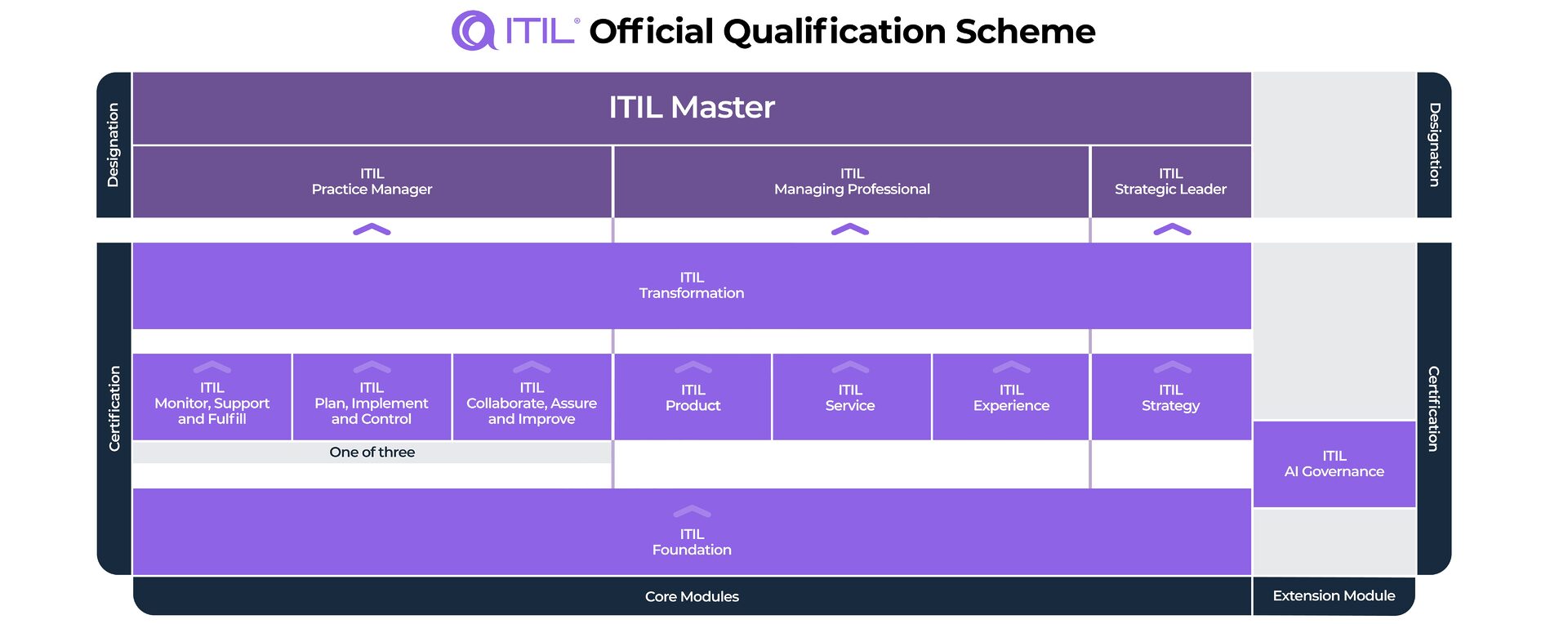
Students must initially pass ‘ITIL Foundation’. Once a student has obtained ‘ITIL Foundation,’ they can go on to pass the ‘Practice Manager,’ ‘Managing Professional’ or ‘Strategic Leader’ streams. Obtaining all of the Practice Manager,’ ‘Managing Professional’ and ‘Strategic Leader’ certifications allows students to become an ‘ITIL Master.’ Students interested in a specific area of ITSM can take one of the four ITIL extension modules. These do not contribute to the ITIL Pathway.
How much is ITIL certification worth?
According to Payscale, certified ITIL practitioners can earn between $51,000 and over $259,000 (or £39,000 and over £200000), depending on their experience, role, and certification level. Even sitting a Foundation course can have significant benefits for ITSM professionals.
How does ITIL work?
ITIL provides users with a set of best practices for creating optimized IT services. It establishes cultures of continuous improvement, ensuring that users can enjoy long-term benefits with IT services continually aligned with business goals and strategies. It also offers proven practices for resource optimization and continuous improvement.
How can ITIL benefit businesses?
ITIL 4 is a modern framework that fully equips users to optimize their IT practices. It creates cultures of continuous improvement, enabling organizations to deliver top-quality IT products and services whilst also continually reviewing their own processes. The framework is also highly adaptable and can work alongside other popular approaches, such as DevOps. Finally, the framework is set to continue evolving to accommodate developments in technology and best practices. This makes ITIL future-proof for practitioner organizations.
Who are PeopleCert?
PeopleCert is the owner of and accrediting body for a number of best practice frameworks, including PRINCE2, PRINCE2 Agile, MSP, ITIL 4, and AgileSHIFT.
What is AXELOS?
AXELOS is a trademark of PeopleCert, the organization behind a variety of highly popular best practice frameworks, including ITIL 4, PRINCE2, MSP, and AgileSHIFT.
What other frameworks can complement ITIL?
ITIL 4 can be integrated with several other frameworks, including Agile, DevOps, and Lean. Some practitioners even use it alongside PRINCE2.
To achieve the ITIL® Foundation Bridge qualification, you must successfully pass the ITIL® Foundation Bridge exam. The ITIL exams are available online through a service provided by PeopleCert.
Upon completing this course, you will be equipped to begin preparing for the Foundation exam. To aid in your preparations, this ITIL Foundation eLearning course includes two practice exams designed to mirror the actual exam environment.
Before scheduling your exam, ensure that your device meets the necessary technical standards. For detailed instructions and further assistance, please refer to the PeopleCert website.
You should receive your exam voucher when you’re successfully enrolled on the course. For additional details, check the GEL Support & FAQs page.
ITIL® Foundation Bridge exam
This is a multiple-choice “Objective Test Question” (OTQ) exam consisting of 20 questions
There is a time limit of 30 minutes to complete the exam
The exam is closed book, with only the provided materials being permitted for use
The pass mark for the exam is 65%: you must answer at least 13 out of 20 questions correctly
Passing this exam will allow candidates to proceed to exams for higher-level ITIL qualifications
ITSM stands for ‘IT Service Management’. It involves using policies, procedures, and best practices to optimize IT services for clients and employees.
What is ITIL (Version 5)?
ITIL (Version 5) is the next evolution of ITIL, the world’s most widely adopted framework for IT service management. Building on the foundations of previous ITIL versions, it expands the framework beyond traditional IT service management into a unified model for managing digital products and services end-to-end covering everything from discovery and design through to delivery, support, and continual improvement.
Where earlier versions focused primarily on IT services, ITIL (Version 5) reflects the way modern organisations actually operate: digitally-led, product-centric, and increasingly shaped by AI. It provides the common language, guiding principles, and practical best practices that teams across IT, product, and business functions need to deliver consistent value, adopt AI responsibly, and improve continuously.
What does ITIL stand for?
Previously, ITIL stood for the ‘Information Technology Infrastructure Library’. The framework has evolved to the point where it is updated so often that it cannot be considered a static ‘library’. Because of this, the name no longer stands for anything.
What does the ITIL certification path look like?
Students must initially pass ‘ITIL Foundation’. Once a student has obtained ‘ITIL Foundation,’ they can go on to pass the ‘Practice Manager,’ ‘Managing Professional’ or ‘Strategic Leader’ streams. Obtaining all of the Practice Manager,’ ‘Managing Professional’ and ‘Strategic Leader’ certifications allows students to become an ‘ITIL Master.’ Students interested in a specific area of ITSM can take one of the four ITIL extension modules. These do not contribute to the ITIL Pathway.
How much is ITIL certification worth?
According to Payscale, certified ITIL practitioners can earn between $51,000 and over $259,000 (or £39,000 and over £200000), depending on their experience, role, and certification level. Even sitting a Foundation course can have significant benefits for ITSM professionals.
How does ITIL work?
ITIL provides users with a set of best practices for creating optimized IT services. It establishes cultures of continuous improvement, ensuring that users can enjoy long-term benefits with IT services continually aligned with business goals and strategies. It also offers proven practices for resource optimization and continuous improvement.
How can ITIL benefit businesses?
ITIL 4 is a modern framework that fully equips users to optimize their IT practices. It creates cultures of continuous improvement, enabling organizations to deliver top-quality IT products and services whilst also continually reviewing their own processes. The framework is also highly adaptable and can work alongside other popular approaches, such as DevOps. Finally, the framework is set to continue evolving to accommodate developments in technology and best practices. This makes ITIL future-proof for practitioner organizations.
Who are PeopleCert?
PeopleCert is the owner of and accrediting body for a number of best practice frameworks, including PRINCE2, PRINCE2 Agile, MSP, ITIL 4, and AgileSHIFT.
What is AXELOS?
AXELOS is a trademark of PeopleCert, the organization behind a variety of highly popular best practice frameworks, including ITIL 4, PRINCE2, MSP, and AgileSHIFT.
What other frameworks can complement ITIL?
ITIL 4 can be integrated with several other frameworks, including Agile, DevOps, and Lean. Some practitioners even use it alongside PRINCE2.
Anyone holding any ITIL 4 qualification (excluding ITIL 4 specialist: Acquiring and Managing Cloud Services and ITIL 4 Specialist: Sustainability in Digital and IT
Any ITIL 4 certificate holder looking for a fast, focused route to upgrade to ITIL (Version 5)
What will you learn by taking this course?
How the ITIL best practice framework is used to boost the efficiency, effectiveness, and overall quality of IT-powered products and services
An overview of the tools, methodologies, purpose, and components of the framework
How the guiding principles can help organizations plan, create, implement, and continually improve market-leading IT services
The details of the ITIL certification path
Everything needed to pass the official ITIL foundation bridge certification exam
Why should you take this course?
Good e-Learning is an award-winning online training provider and was independently certified as a “Market Leader” for ITIL online training by Course Conductor
The course includes a free eBook, provided by PeopleCert
The ITIL syllabus offers a comprehensive and modernized look at IT service management
ITIL qualifications are highly valuable and desirable for employers in IT
This online course fully prepares candidates to sit and pass the ITIL Foundation exam on the first attempt
Getting certified can lead to impressive salary gains. According to Payscale, professionals with the ITIL Foundation qualification earn an average base salary of approximately $100,000 (or £41,000)
The course was created with input from leading experts, including the authors of several of the ITIL books
Good e-Learning students avoid ITIL Foundation exam costs thanks to FREE exam vouchers (T&Cs apply)
This ITIL Foundation course is accredited by PeopleCert
This course is accredited by:
Self-Paced eLearning
Price Excludes VAT
$359.00
Fully accredited:
Exam voucher included:
Free handbook included:
Course duration: 8 hours
Access period: 6 months
Tutor support:
Quizzes & practice exams:
Mobile compatible:
Good e-Learning achieves what many thought was not possible – an online course that is straight forward and gets some very complex material across in a fun and engaging manner. The materials are illustrated with easy-to-follow graphics, voice-overs and videos that make the subject matter memorable – especially important for preparing for the exam!
We use cookies to enhance your browsing experience on our website. By clicking “Accept All”, you consent to our use of cookies. However, you may use the "manage cookies" button below to provide controlled consent. For more information you can read our cookie-policy.
Functional Always active
The technical storage or access is strictly necessary for the legitimate purpose of enabling the use of a specific service explicitly requested by the subscriber or user, or for the sole purpose of carrying out the transmission of a communication over an electronic communications network.
Preferences
The technical storage or access is necessary for the legitimate purpose of storing preferences that are not requested by the subscriber or user.
Statistics
The technical storage or access that is used exclusively for statistical purposes.The technical storage or access that is used exclusively for anonymous statistical purposes. Without a subpoena, voluntary compliance on the part of your Internet Service Provider, or additional records from a third party, information stored or retrieved for this purpose alone cannot usually be used to identify you.
Marketing
The technical storage or access is required to create user profiles to send advertising, or to track the user on a website or across several websites for similar marketing purposes.