
Which shift is your IT organisation currently spending the most energy fighting?
That’s the question Adam Griffith, ITIL® Architect and ITIL (Version 5) Master, put to the audience during our recent webinar, in association with PeopleCert: From ticket closer to strategic asset: how the role of IT is changing in 2026. The answer was unanimous, with 100% saying it was reining in shadow AI experiments into governed, domain-specific value streams.
That result – and the webinar in general – were a timely reminder of just how quickly the pace of IT is changing, and that both organisations and individuals need to adapt to work optimally within it.
If any of this sounds familiar, we’ve pulled together a recap covering the key points from Adam’s session. And if you’d prefer to watch back instead, you’ll find the recording linked below.
The host
🎤 Adam Griffith, Senior Architect, ITIL®
The 3 essential evolutions in IT
Adam opened by explaining that the progression from ticket closer to strategic asset comes down to three significant evolutions. Modern IT needs to:
- Alter their operational architecture and flow
- Measure value through human experience and business impact
- Govern advanced capabilities and transform their workforce to support that
Each evolution carries two key shifts within it, so six in total, driving this change forward.
Adam then broke each one down in turn, going into more detail on what this means in practice.
👉 See where you sit between ticket closer and strategic asset
Altering operational architecture and flow
Shift one: ecosystem-driven digital product and service management
Adam explained that this first shift is a move away from service management in isolation, where ownership, accountability, and communication all sit fragmented across teams. Working like this creates friction and delayed hand-offs, with partnerships that struggle to scale.
Instead of these fragmented ways of working, teams should be moving towards ecosystem-driven product and service management, which includes: holistic value co-creation, unified lifecycle ownership, enhanced supply chain agility, and direct alignment – across both internal and external, business and customer.
As Adam put it: “Strategic asset IT needs to think about this in an end-to-end fashion, identifying ways to understand and own, not just a supply chain, but a web of upstream partners and suppliers that contribute to your capability.”
Shift two: flexible, interconnected value streams
The starting point here is linear gatekeeping. “If I have these teams that have been organised around processes,” Adam explained, using separate change enablement and incident management divisions as examples, “This is where problem management begins and ends.” In turn, this leads to artificial bottlenecks and significant bureaucratic delay. Processes with flawed hand-offs also lose context along the way, and there becomes a culture where compliance is prioritised at the expense of value.
The shift moves away from this towards flexible, interconnected value streams, Adam explained, following a dynamic stepping stone orchestration. For this to be realised, there needs to be multi-stakeholder collaboration, accelerated flow, shorter feedback loops, and context-driven governance.
Where the ITIL (Version 5) Lifecycle comes in
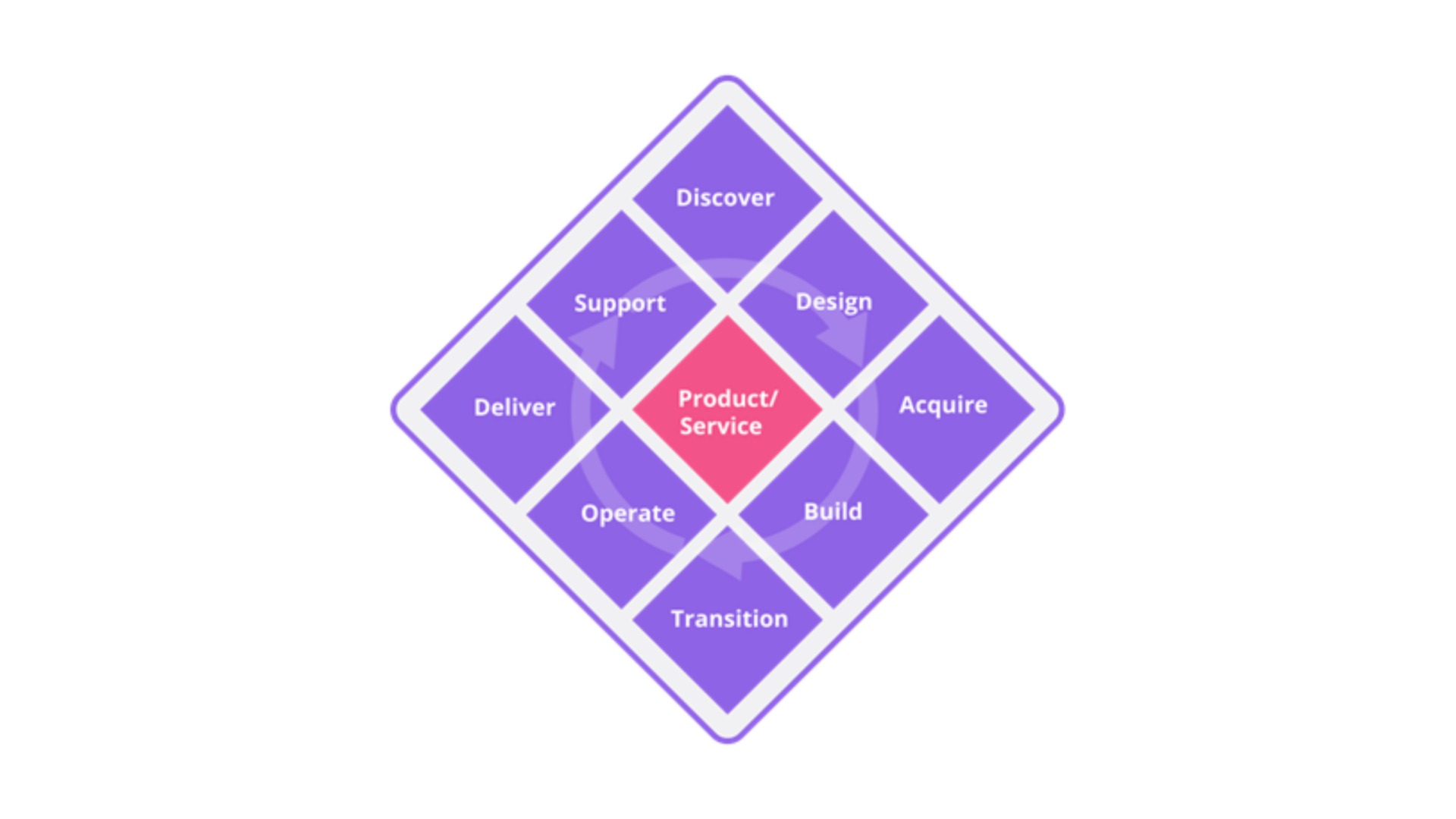
Both shifts feed into the ITIL (Version 5) Product and Service Lifecycle (pictured below), which strengthens the previous ITIL Value System with a clearer, modular value chain model – think of them like the flexible stepping stone structure mentioned above. Providers move through eight stages, which are highly flexible and based on the reality and context of the situation, rather than a fixed linear order.
The Lifecycle provides an end-to-end, experience-driven understanding of how value is created, helping you alter your operational architecture and flow. As Adam explained, one of the most important lightbulb moments for him came from a conversation with a technology executive, who said: “This really does describe the cradle-to-grave pattern that our products and services do go through.”
👉 More from GEL: What is ITIL (Version 5)?
Measuring value through human experience and business impact
Shift three: human-centric experience and dynamic impact agreements
Adam moved on to the second evolution, starting with a shift away from system performance and static SLAs. Under this static approach, organisations run into the “watermelon effect”: metrics that look green on the surface but are red underneath. Technical metrics end up misaligned, while service level agreements stay rigid and contractual. Then there’s also the damaging blind spots that form around user and employee sentiment.
Instead, Adam explained, the shift should be towards human-centric experience and dynamic impact agreements. For your organisation this means: value gets measured holistically rather than through a single metric, friction reduces across both operational and digital touchpoints, and outcomes stay aligned with what the business really needs. Feedback also becomes continuous, and the approach adapts as circumstances change.
Adam described this as “not just looking at what we provide, but how we provide it.”
Shift 4: adaptive operational readiness
In this next shift, Adam discussed moving away from rigid annual strategic planning, an approach that leaves organisations exposed to strategic drift and obsolescence. He also noted that big-bang transformation brings fatigue, and control becomes more assumed than real, with operational awareness lagging behind as a result.
The shift moves towards adaptive operational readiness instead, which includes: continuous horizon scanning and sensing, embedded change resilience, and optimised execution in complexity. In other words, “Let’s move towards our ability to flourish in an environment that is complex on a continual basis.”
VUCA is standard operating procedure
Adam tied this focus on adaptive operations to VUCA – situations that are volatile, uncertain, complex and ambiguous. He noted that it used to be treated as the exception in ITSM, but now it’s become business as usual.
This requires organisations to:
- Revisit strategy more frequently as assumptions change
- Shorten strategic cycles to respond to shifting conditions
- Strengthen situational awareness of internal and external signals
- Adapt plans during implementation as new information emerges
👉 More from GEL: The shifting role of IT in 2026
Governing advanced capabilities and transforming the workforce
Shift five: governed and operationalised AI
Adam introduced the final evolution with a move away from ad-hoc AI experiments, where shadow AI creates security exposure and isolated proof-of-concept projects turn into vanity projects that never scale. Quality stays unpredictable and hallucinations creep in, while technical debt builds up across fragmented tools.
Governed and operationalised AI looks very different. AI-enabled value streams are properly governed rather than ad hoc, while trust and compliance sit embedded at an enterprise level. ROI and business outcomes are also measurable, with architecture that is built to scale.
AI governance in action
Adam noted that there’s been a “long-standing misunderstanding of what exactly governance is about.” He added, “In ITIL, we define governance as something that helps to direct and control the work.”
Adam gave the audience some useful frameworks and guidance around this governance, highlighting the six components of AI governance, which are influenced by ISO 38500:
- Direction
- Policy
- Performance
- Capability
- Delegation
- Accountability
Adam also ran through the ITIL AI capability model, which is a functional classification of what an AI system can do, in six capabilities:
- Creation
- Curation
- Clarification
- Cognition
- Communication
- Coordination
It gives organisations a shared way to talk about AI applications, and helps tailor risk profiles and controls to what each function is really doing.
👉 Read next: ITIL 4 vs ITIL (Version 5)
Shift six: strategic relationship builders and value orchestrators
The last shift moves away from isolated technical specialists and reactive operators, where a narrow technical focus limits what people can offer. This transactional, ticket-centric mindset creates communication gaps and friction with the wider business, with workforce capabilities staying stagnant as a result.
Instead, Adam explained that we should be moving towards strategic relationship builders and value orchestrators, with genuinely holistic workforce capabilities that encourage cross-functional orchestration. A big part of this shift is proactive strategic partnerships, a key driver in moving IT away from being only a support function.
Take your ITIL training to the next level
The six shifts Adam walked through show where ITSM is heading, and ITIL (Version 5) sits right at the centre of it. If your team’s ready to move from reactive operators to strategic partners, our ITIL courses can help get you there.