What is ITIL® (Version 5)?
And How It Can Advance Your Career
| Executive Summary ITIL (Version 5) is the latest evolution of the world’s most widely adopted IT service management framework. Updated for the realities of modern digital organisations, it expands beyond traditional IT service management into a unified model for managing digital products and services end-to-end. This article explains what ITIL (Version 5) is, what’s new, who it’s for, and how gaining ITIL (Version 5) certification can significantly advance your career in IT, digital services, and beyond. |
Introduction: Why ITIL® Still Matters, and Why It Just Got Better
For decades, ITIL has been the framework that IT professionals around the world rely on to manage services effectively, speak a common language, and demonstrate their expertise to employers. Millions of people hold ITIL certifications. Thousands of organisations have built their service management practices around it.
But the world has changed. Organisations are no longer just running IT services, they’re managing complex digital products, navigating AI-driven operations, and serving customers and employees who expect seamless, intelligent experiences. Traditional IT service management frameworks, however well-established, needed to evolve.
ITIL (Version 5) is that evolution.
What is ITIL (Version 5)?
ITIL (Version 5) is the next generation of the ITIL framework, updated to reflect the realities of modern digital organisations. It builds on the core concepts, guiding principles, and Service Value System that ITIL professionals already know and trust, while significantly expanding the scope and depth of the framework to address the challenges organisations face today.
Where previous versions of ITIL focused primarily on IT service management, ITIL (Version 5) takes a broader view. It provides a unified model for managing digital products and services together, end-to-end, across the entire organisation, connecting strategy, development, delivery, operations, and continual improvement in a single, coherent framework.
At its heart, ITIL (Version 5) is built around four major new themes that reflect how high-performing digital organisations operate:
- AI-native guidance: practical direction for working in AI-enabled environments and governing AI responsibly
- A full digital product and service lifecycle: an eight-stage model covering Discover, Design, Acquire, Build, Transition, Operate, Deliver, and Support
- Customer and employee experience: placing experience at the centre of how services are designed and delivered
- Sustainability: embedding responsible, long-term thinking into the framework at every level
What’s New in ITIL (Version 5)? How Does It Differ from ITIL 4?
ITIL (Version 5) is an evolution, not a revolution. Roughly 40% of the content is retained from ITIL 4, around a third has been significantly updated, and the rest is entirely new. If you already hold an ITIL 4 qualification, your knowledge and certification remain valid and valuable, ITIL (Version 5) builds on what you already know.
The key differences are in scope, operating model, and the treatment of AI, experience, and sustainability.
From services to products and services
ITIL 4 focused on IT service management, with scope that could be extended beyond IT. ITIL (Version 5) is explicitly enterprise-wide from the outset, designed to support business, product, and technology teams working together, not just IT operations.
A new digital lifecycle
ITIL 4 used a Service Value Chain with six activities. ITIL (Version 5) introduces a new digital product and service lifecycle with eight stages. Discover, Design, Acquire, Build, Transition, Operate, Deliver, and Support, giving teams a clearer, more complete picture of how value is created and delivered.
AI built in, not bolted on
In ITIL 4, AI was acknowledged mainly within specific specialist modules. In ITIL (Version 5), AI is native to the framework, there is an AI Capability Model and a dedicated AI Governance extension module, reflecting the reality that AI now touches every aspect of how organisations operate.
Experience at the core
Customer and employee experience (CX/EX) moves from a secondary consideration to a central driver of value across the entire lifecycle.
Sustainability as a design principle
Sustainability is no longer an add-on. In ITIL (Version 5), responsible and long-term thinking is built into how services and products are designed, delivered, and improved.
A simpler certification structure
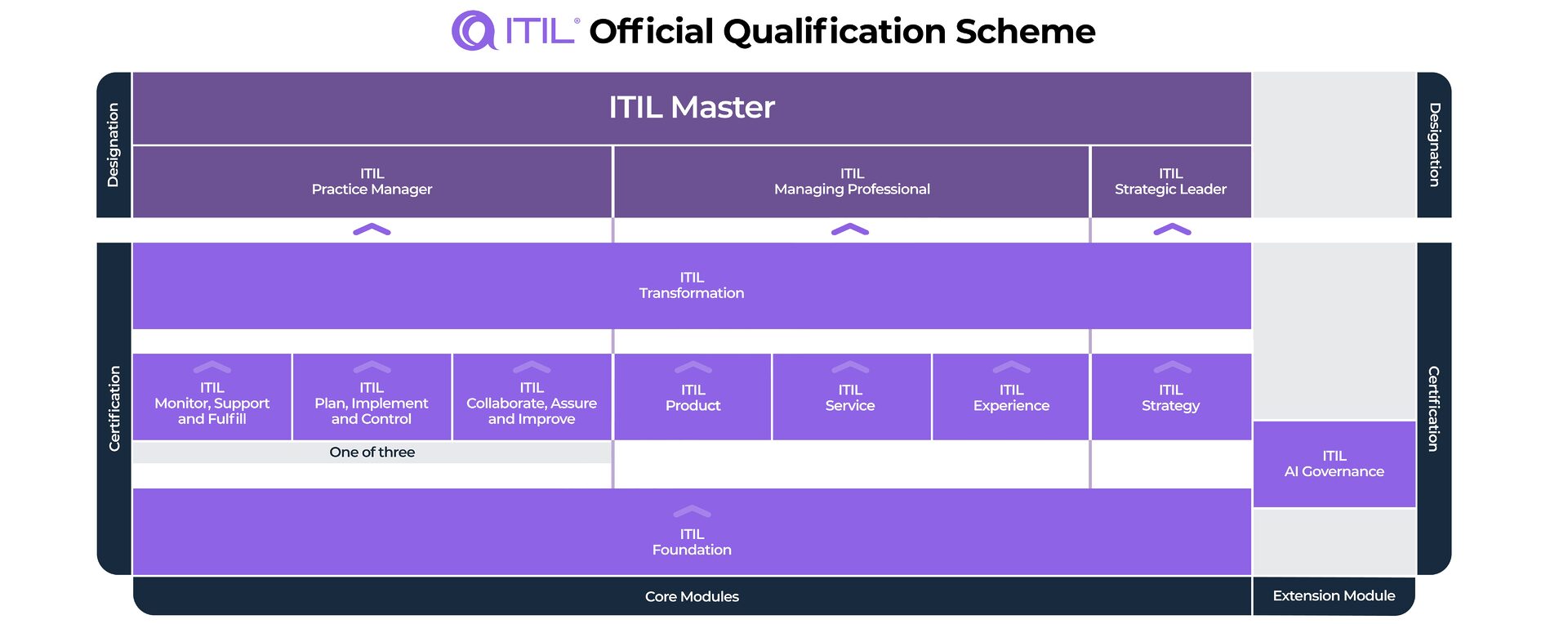
ITIL 4’s certification scheme was comprehensive but complex, with multiple overlapping pathways. ITIL (Version 5) introduces a cleaner, more progressive structure: Foundation as the entry point, followed by role-relevant advanced modules and a mandatory Transformation module for higher-level designations, leading to the ITIL Master.
The ITIL (Version 5) Certification Scheme
ITIL Foundation (Version 5)
The entry point for the entire scheme. Foundation introduces the core concepts, the Service Value System, the digital product and service lifecycle, value stream mapping, and the guiding principles. It is suitable for everyone from junior IT staff to senior digital leaders, and there are no formal prerequisites. The Foundation exam consists of 40 multiple-choice questions, with a 60-minute time limit and a pass mark of 65% (26/40).
Advanced modules
Beyond Foundation, ITIL (Version 5) offers a series of role-relevant specialist modules organised into three streams, covering areas such as product management, service management, experience, transformation, and AI governance. Successfully completing the defined modules within a stream leads to a designation. Achieving all three stream designations leads to the highest recognition: ITIL Master.
The Transformation module
A mandatory module for all advanced designations, the Transformation module acts as the bridge between ITIL concepts and application in the real world. This module will help ensure your ITIL implementations run smoothly and achieve results.
Transitioning from ITIL 4
- ITIL 4 Foundation holders can generally progress directly to advanced ITIL (Version 5) modules without retaking Foundation
- ITIL v3 Foundation holders are advised to take ITIL Foundation (Version 5) as the content shift is more significant
- ITIL 4 and ITIL (Version 5) will run in parallel during a transition period, so learners can complete existing paths before migrating
Who is ITIL (Version 5) For?
One of the strengths of ITIL (Version 5) is that it is deliberately designed to be relevant at every level of an organisation, from the service desk to the boardroom.
Early-career professionals and juniors
For those just starting out in IT support, operations, or digital services, ITIL Foundation (Version 5) provides a clear, modern vocabulary for products, services, value streams, and experience, making it easier to understand how day-to-day work contributes to broader business outcomes. It is one of the most widely recognised entry-level certifications in IT, valued by employers across sectors and around the world.
Mid-level practitioners
For service owners, product owners, DevOps engineers, SREs, and business analysts, ITIL (Version 5) brings clarity to how value streams work across teams, how to connect practices into an end-to-end flow, and how AI fits into modern operations. The move to integrated digital product and service management means practitioners can collaborate more effectively with product and engineering teams, rather than working in traditional ITSM silos.
IT managers and team leads
ITIL (Version 5) gives managers a unified model to align teams around measurable value, experience, and sustainability, rather than just uptime and ticket volumes. The practical, flexible guidance is designed to be applied from day one — supporting iterative improvement rather than costly, disruptive overhauls.
Senior leaders and digital executives
For CIOs, CDOs, and Heads of Digital, ITIL (Version 5) is more than a certification, it is a strategic framework for running digital-first, human-centric organisations. Built-in guidance on governance, AI adoption, and sustainability supports responsible transformation and long-term resilience. The simplified qualification scheme, including the Transformation and AI Governance modules, can be used to shape leadership development programmes across entire teams and organisations.
How ITIL (Version 5) Can Advance Your Career
It is one of the most in-demand certifications in IT
ITIL qualifications are actively sought by employers across IT, digital services, consulting, financial services, government, healthcare, and virtually every sector that relies on technology. As of October 2025, the average UK salary for an ITIL-qualified IT professional is £51,500, and ITIL-certified professionals consistently command higher salaries than their non-certified peers.
It signals you are current
Holding an ITIL (Version 5) certification demonstrates that your knowledge reflects the way modern digital organisations actually work, with AI, product-centric delivery, and experience at the centre. In a market where many professionals still hold ITIL 4 or earlier qualifications, being certified on the latest version is a meaningful differentiator.
It gives you a shared language
One of ITIL’s most practical career benefits is often underestimated: it gives you a common language that works across teams and organisations. Whether you are joining a new employer, moving into consulting, or working across a complex enterprise, ITIL-certified professionals can engage immediately and credibly with service management practices and principles.
It opens the door to progression
ITIL Foundation (Version 5) is not just a standalone qualification, it is the gateway to an entire progression pathway, from specialist modules through to the ITIL Master designation. For ambitious professionals, the certification scheme provides a clear, structured roadmap for continued development and increasing seniority.
It is globally recognised
ITIL certifications are recognised in virtually every country in the world and are owned and administered by PeopleCert, one of the most established certification bodies in the industry. Whether your career ambitions are local or international, an ITIL qualification travels with you.
Frequently Asked Questions
Do I need any prior knowledge to take ITIL Foundation (Version 5)?
No. There are no formal prerequisites for ITIL Foundation (Version 5). It is designed to be accessible to anyone interested in IT service management or digital product and service management, regardless of their background or experience level.
I already have ITIL 4 Foundation — do I need to retake ITIL Foundation?
Generally, no. ITIL 4 Foundation holders can typically progress directly to advanced ITIL (Version 5) modules. However, it is worth checking the current PeopleCert guidance as transition pathways may be updated over time.
If you would like to learn about the new concepts in ITIL (Version 5) a bridging exam will be available to help you transition from ITIL 4 foundation to ITIL (Version 5)
How long does it take to prepare for the ITIL Foundation (Version 5) exam?
Most candidates prepare through a structured e-learning course equivalent to two to three days of learning. Good e-Learning’s ITIL Foundation (Version 5) course includes over 7 hours of video instruction, knowledge checks, and two full PeopleCert practice exams to make sure you are thoroughly prepared.
What if I don’t pass first time?
You can add PeopleCert’s Take2 option at checkout for a discounted retake, or become a PeopleCert Plus member to get a free retake included with every exam you sit, alongside access to 150+ official eBooks, mock exams, and a full professional development programme.
Conclusion: The Right Framework, at the Right Time
ITIL has guided IT professionals and organisations for decades. ITIL (Version 5) ensures it remains relevant for the decades ahead — built for a world where digital products and services, AI, and human experience are inseparable from how organisations operate and compete.
Whether you are just starting your career, looking to deepen your expertise, or leading a team through digital transformation, ITIL (Version 5) gives you the knowledge, the language, and the credential to make a real difference.
The framework has evolved. The question is whether you will evolve with it.
| Ready to get started? Join the Early Bird list and be the first to know when our new course is released and get a special Early Bird Discount! |
ITIL® is a registered trademark of PeopleCert. All rights reserved.